

What does it mean for an AI system to be high-risk?
The term can be misleading. An AI system is not considered high-risk simply because it is complex, powerful or technically advanced.
What matters is how it is used, the context in which it operates and the consequences it may have for people, safety or particular processes.
Two tools may rely on similar technology. One helps organise documents. The other analyses job applicants and recommends who should continue in a recruitment process. The technology may be similar, but the use is completely different. Under the AI Act, that difference matters.
How can we tell whether an AI system may be high-risk?
The AI Act provides two main routes for determining whether an AI system is high-risk. There is no need to memorise every article or annex; the important thing is to understand the logic.
First, we check certain systems connected with regulated products. If that route does not apply, we examine uses of AI that the Regulation regards as particularly sensitive.
Article 6(1) and Annex I: systems linked to regulated products
The first route concerns AI systems that are part of certain products regulated in the European Union, including areas such as machinery and medical devices.
In simplified terms, we need to check whether the AI is part of a product covered by the legislation listed in Annex I, whether it performs a safety function and whether that product is subject to a third-party conformity assessment. When the conditions in Article 6(1) are met, the system is high-risk.
For many companies, this will not be the most common route. That is why the second route is often easier to recognise.
Article 6(2) and Annex III: when the use of AI matters
Annex III identifies areas in which the use of AI may have particularly significant consequences. Examples include employment and recruitment, education, certain biometric uses, critical infrastructure, access to essential services, migration and border control, law enforcement and certain uses in the administration of justice.
This does not mean that every piece of software used in those areas is automatically high-risk. We still need to examine the specific function performed by the system.
A simple example: AI used to select candidates
Imagine that a company uses an AI system to analyse CVs, score applicants and recommend who should move forward in a recruitment process.
The most useful question is not whether it uses generative AI or which model sits behind it. The useful question is whether it is intervening in a decision about access to employment. That takes us directly to the uses listed in Annex III.
Now consider a different tool that only converts CVs into a standard format, organises documents or helps schedule interviews. It also uses AI, but its role in the decision may be very different. Knowing that a company uses AI is not enough; we need to know what it uses it for.
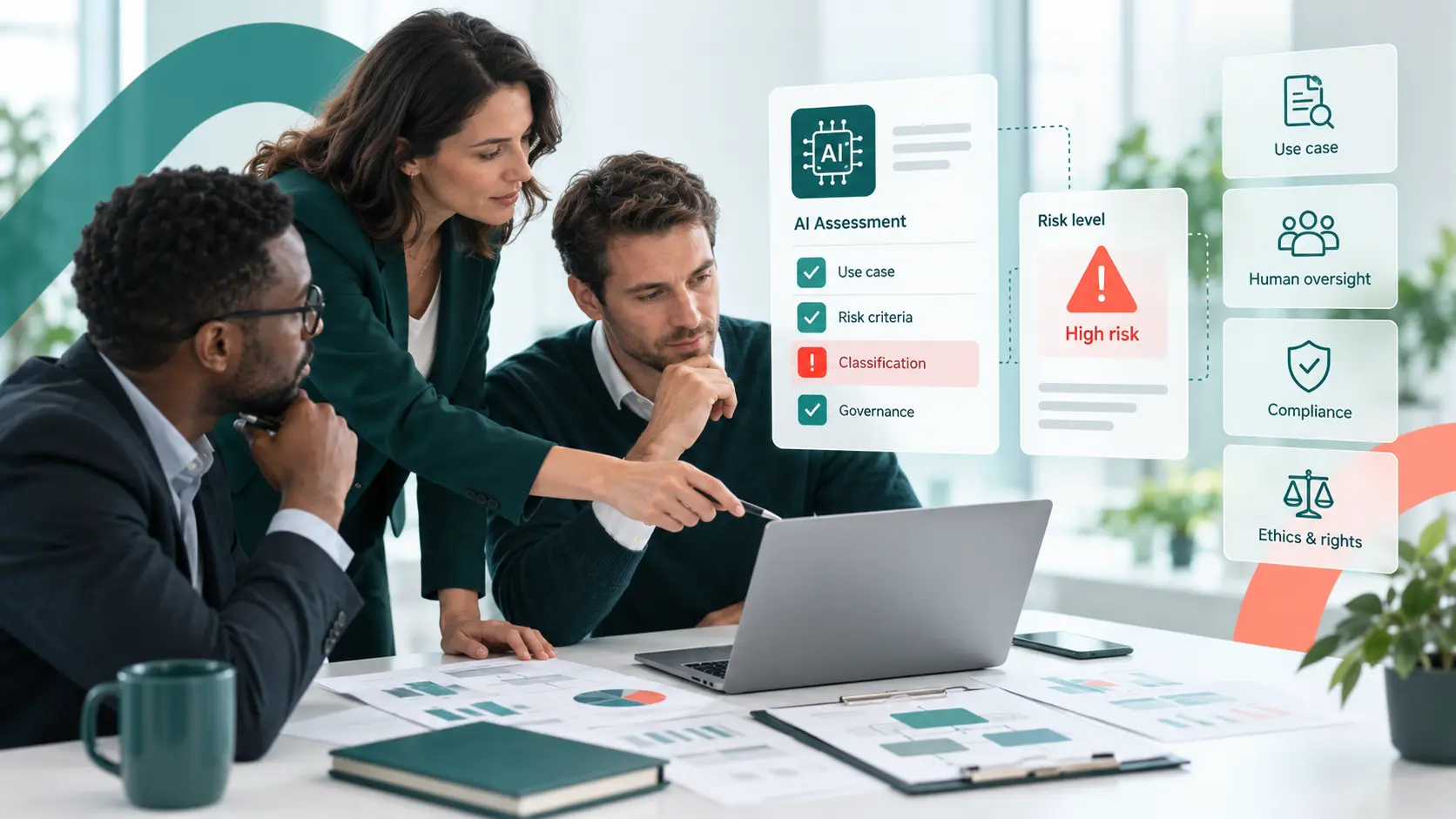
Article 6(3) exceptions: being listed in Annex III does not always end the assessment
The AI Act allows certain Annex III systems not to be treated as high-risk when, among other conditions, they do not pose a significant risk to health, safety or fundamental rights and do not materially influence the outcome of a decision.
This may include limited procedural tasks, preparatory tasks or systems that improve the result of a previously completed human activity. Put simply, helping to prepare a decision is not the same as taking it or materially shaping it.
There is an important qualification: where the system performs profiling of natural persons in these circumstances, it is considered high-risk. Each system should therefore be assessed individually rather than classified automatically.
Four questions to start classifying an AI system
Before opening the Regulation, ask four practical questions:
- What does the system actually do inside the organisation?
- Which people, processes or decisions does it affect?
- Does it match any use regulated under Annex I or Annex III?
- Does it merely support a decision, or does it materially influence it?
- If we cannot clearly explain what an AI system does, we are probably not ready to classify it properly. Understanding comes before compliance.
What should we document?
If we conclude that a system is not high-risk, we should still be able to explain why.
A useful record identifies the system, its purpose, the process in which it is used, the people affected, the role played by AI, the checks performed against Annexes I and III, the conclusion reached and the information on which that conclusion was based.
When a provider decides that an Annex III system is not high-risk, the AI Act requires that assessment to be documented. Even where our organisation is not the provider, keeping our own analysis remains sound governance. The answer should not depend on one person’s memory.
Why the classification needs to be reviewed
AI systems change. A tool may begin with a limited task and later be introduced into another process, use new data, generate recommendations or gain more influence over a decision.
Classification should therefore form part of the organisation’s AI inventory and governance arrangements, rather than being a label applied once and forgotten.
The question is not only whether the system is high-risk. We must also be able to explain why we reached that conclusion and what evidence supports it. That is where compliance, risk and governance begin to connect.
Not sure where your system fits?
It is perfectly normal if the answer is not obvious at first. A good place to start is to organise the information: which systems you use, what they are used for, who manages them and which decisions they may affect.
Start the Céntrika assessment →
Use the Céntrika assessment to obtain an initial view of your organisation’s AI governance, risk and compliance and identify signs that a system may fall within a high-risk scenario.
The assessment provides initial guidance and does not replace a system-specific legal or technical evaluation.